Used Hybrid Car Checklist: Battery, Brake Wear, Service Records, and VIN Checks

Buying a used hybrid car in Canada can be a smart choice if you want better fuel economy without going fully electric. But a hybrid is not just a regular gas car with better mileage. It has a gasoline engine, an electric motor, a high-voltage battery, regenerative braking, specialized cooling systems, and electronic controls that should be checked before purchase.
Before buying a used hybrid, verify the hybrid battery condition, brake wear, service records, recall status, fuel economy, warning lights, charging equipment if it is a plug-in hybrid, and the vehicle’s identity through the VIN. A good hybrid can save money over time, but a poorly maintained one can bring expensive battery, brake, cooling, or electrical problems after the sale.
Use this used hybrid car checklist to inspect the vehicle with more confidence before you make an offer.
Understand what type of hybrid you are buying
Not all hybrids work the same way. The first step is to know whether you are looking at a regular hybrid, a plug-in hybrid, or a mild hybrid.
A regular hybrid, often called a hybrid-electric vehicle or HEV, uses a gasoline engine and an electric motor. The battery is charged by the vehicle itself through driving and regenerative braking. It is not plugged in.
A plug-in hybrid electric vehicle, or PHEV, has a larger battery that can be charged from an outlet or charging station. It can usually drive a limited distance on electric power before switching to gasoline or blended operation.
A mild hybrid uses a smaller electric system to support the gasoline engine, but it usually cannot drive on electric power alone.
Natural Resources Canada explains that hybrids use both an internal combustion engine and an electric motor to improve efficiency, especially in city driving. It also notes that plug-in hybrids have higher-capacity batteries that can be recharged by plugging in and can operate in electric-only mode for some driving. For buyers, this matters because inspection priorities change depending on the hybrid type.
Before you inspect the vehicle, decode the VIN and confirm the exact trim, powertrain, and model year using a VIN decoder. This helps you verify that the seller’s listing matches the actual vehicle.
Check the hybrid battery condition
The hybrid battery is one of the most important components to evaluate. It is different from the small 12-volt battery that starts accessories and electronics. The hybrid battery helps power the electric motor and supports the vehicle’s fuel-saving system.
A weak hybrid battery can reduce fuel economy, trigger warning lights, limit electric assist, or require costly replacement. Some older hybrids remain reliable for years, but battery condition should still be checked carefully.
Ask the seller:
- Has the hybrid battery ever been replaced?
- Has the battery ever triggered a warning light?
- Has the vehicle had hybrid-system repairs?
- Is there a battery health report?
- Is any hybrid battery warranty still active?
- Was the car mostly used for city driving, highway driving, or short trips?
- Has the vehicle ever sat unused for long periods?
Some hybrid batteries can be tested by a dealer, hybrid specialist, or qualified mechanic. A proper inspection may include diagnostic scanning, battery module data, state-of-health indicators, voltage variation, cooling fan operation, and stored fault codes.
Do not rely only on the dashboard saying the vehicle is “ready.” A hybrid can start and drive while still hiding battery deterioration.
Watch for hybrid battery warning signs
During the inspection and test drive, pay attention to how the hybrid system behaves.
Possible warning signs include:
- Hybrid system warning message
- Check engine light
- Reduced fuel economy
- Gas engine running constantly
- Battery charge level rising and falling unusually fast
- Weak acceleration
- Loud hybrid battery cooling fan
- Unusual smell from the rear seat or cargo area
- Warning lights that return after being cleared
- Seller claims the warning light is “just a sensor”
A warning light does not always mean the battery is failing, but it does mean the vehicle should be scanned before purchase. Ask for diagnostic codes, not guesses.
Inspect the 12-volt battery too
Many buyers focus on the high-voltage battery and forget the 12-volt battery. In hybrids, the 12-volt battery still matters because it powers key electronics and control systems. A weak 12-volt battery can cause confusing warning lights, starting problems, accessory failures, or strange electronic behaviour.
Ask when the 12-volt battery was last replaced. If it is old, weak, or original on an older vehicle, budget for replacement. This is usually far cheaper than hybrid battery work, but it can still affect the buying decision.
Check brake wear carefully
Hybrids use regenerative braking, which captures energy during slowing and sends it back to the battery. This can reduce wear on the friction brakes, especially in city driving. That sounds good, but it can also create a different problem: brakes may be used less often and can develop rust, sticking, or uneven wear if not maintained.
Do not assume a hybrid’s brakes are fine just because the vehicle has low mileage.
Ask the mechanic to inspect:
- Brake pads
- Rotors
- Calipers
- Brake lines
- Parking brake
- Brake fluid
- Regenerative braking behaviour
- ABS warning lights
- Brake pedal feel
During the test drive, listen for grinding, scraping, pulsing, vibration, or a soft brake pedal. A hybrid should slow smoothly when switching between regenerative braking and friction braking.
If the car has been driven lightly or parked for long periods, brake corrosion may be more important than pad thickness.
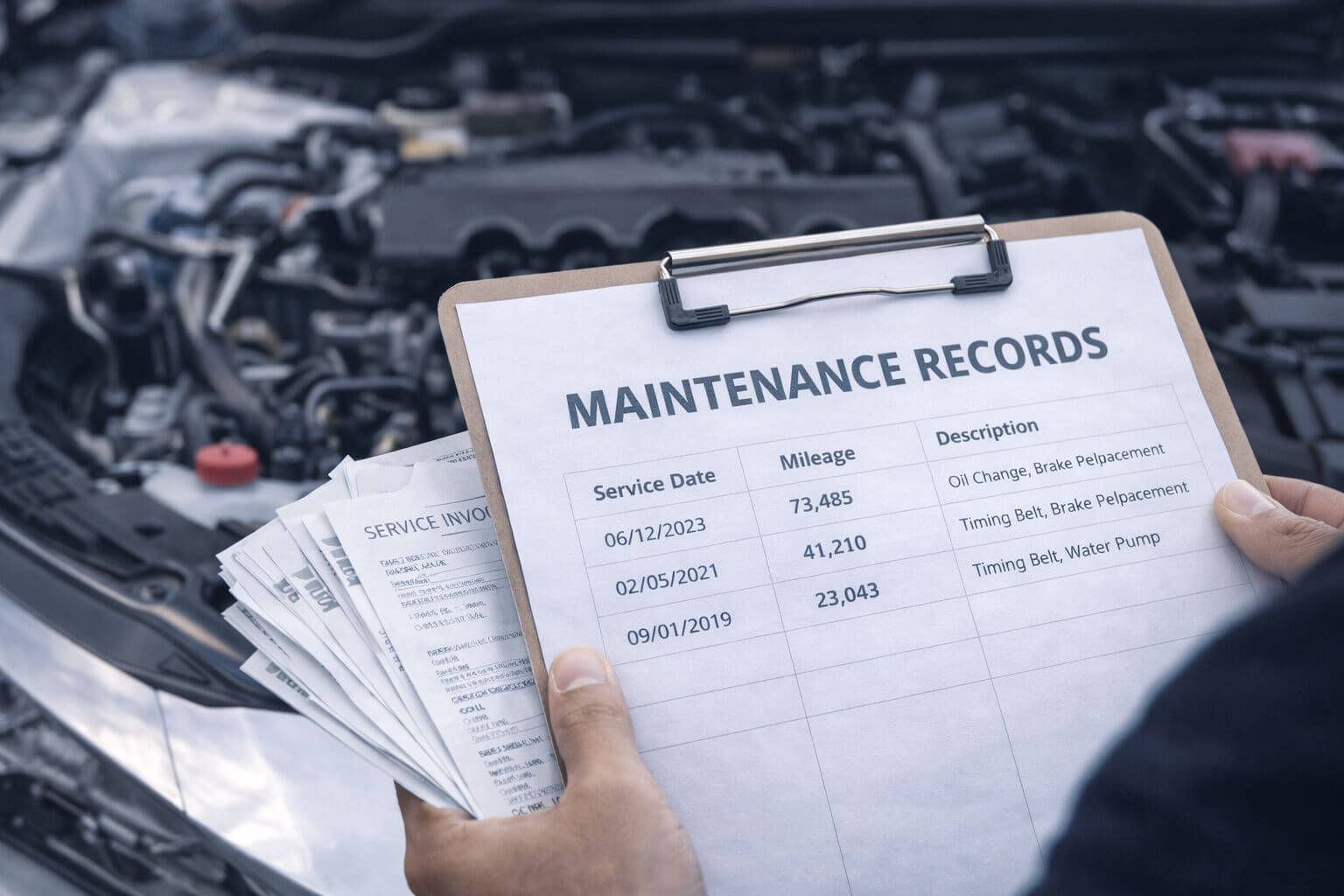
Review service records
Service records matter on any used car, but they are especially useful on hybrids because they show whether the owner understood the vehicle’s special maintenance needs.
Ask for records showing:
- Oil changes
- Coolant service
- Brake inspections
- Brake fluid changes
- Transmission or transaxle service
- Hybrid system inspections
- Battery cooling system maintenance
- Cabin air filter replacement
- Engine air filter replacement
- Spark plug replacement
- Recall completion
- Software updates
- Tire replacement and rotations
- 12-volt battery replacement
A hybrid still has a gasoline engine, so normal engine maintenance still matters. Do not let the word “hybrid” distract you from checking oil leaks, coolant condition, transmission behaviour, exhaust condition, and engine performance.
Check the battery cooling system
Many hybrid batteries rely on fans, vents, ducts, or cooling pathways to manage temperature. If those vents are clogged with dust, pet hair, dirt, or cargo debris, the battery may run hotter than intended.
Check the owner’s manual or ask a hybrid technician where the cooling intake is located. It may be near the rear seat, cargo area, or side trim depending on the model.
Look for:
- Blocked battery vents
- Pet hair around intake areas
- Dust buildup
- Loud cooling fan noise
- Interior panels that appear removed or damaged
- Signs of water intrusion near battery components
A clogged cooling path can shorten battery life and cause performance issues.
Check recalls before buying
Hybrid vehicles can have recalls related to batteries, software, braking systems, fuel systems, electrical components, airbags, steering, or other safety-related parts. Before buying, check recall status using the VIN and confirm whether recall repairs were completed.
Use a recall check before purchase, then verify any open campaigns with the manufacturer or dealer.
Canada’s official recall resources allow consumers to search recalls and safety alerts, while Transport Canada’s vehicle recall database records recalls monitored by its Defect Investigations and Recalls Division.
Ask the seller:
- Are there any open recalls?
- Were previous recall repairs completed?
- Can a dealer confirm completion by VIN?
- Are there hybrid battery, inverter, brake, or software recalls?
- Are parts available if a recall is still open?
An open recall is not always a deal-breaker, but it should be understood before purchase.
Inspect for inverter and hybrid system issues
The inverter and hybrid control systems are essential parts of many hybrid vehicles. They help manage power between the battery, electric motor, and gasoline engine. Repairs can be expensive, so warning signs should not be ignored.
A qualified inspection should check:
- Hybrid control module codes
- Inverter operation
- Inverter coolant level
- Inverter coolant pump operation
- High-voltage cable condition
- Warning lights
- Software updates
- Previous hybrid-system repairs
Do not touch high-voltage components yourself. Orange cables and high-voltage parts should only be handled by trained technicians.
Test drive the hybrid properly
A short drive around the block is not enough. You need to observe how the vehicle switches between electric and gasoline operation, how it brakes, how it accelerates, and whether warning lights appear after driving.
During the test drive, check:
- Smooth startup
- Normal gas engine engagement
- Smooth transition between gas and electric power
- Regenerative braking feel
- Acceleration from a stop
- Highway acceleration
- Noise from the engine bay
- Brake feel
- Steering feel
- Warning lights
- Fuel economy display
- Battery charge behaviour
If the vehicle is a plug-in hybrid, test electric-only mode if enough charge is available. Confirm that the gasoline engine starts when expected and that the vehicle transitions smoothly.
For plug-in hybrids, test charging equipment
If the hybrid is a PHEV, treat the charging system as part of the inspection.
Check:
- Charging port condition
- Charging cable
- Included adapters
- Home charging equipment, if included
- Charging error messages
- Charge door operation
- Battery range after charging
- App or connected services transfer
- Whether the vehicle accepts a charge
Ask the seller whether they regularly charged the vehicle. A PHEV that was rarely plugged in may still operate, but it may not deliver the fuel savings buyers expect.
Compare fuel economy expectations
Hybrids are often bought for fuel savings. But real-world fuel economy depends on driving style, trip length, temperature, terrain, tire condition, and maintenance.
Natural Resources Canada provides fuel consumption ratings and vehicle-efficiency tools that can help buyers compare models. Its guidance notes that choosing a fuel-efficient vehicle that meets everyday needs can save money over time, and that fuel is an expense buyers continue paying long after purchase.
Before buying, compare the vehicle’s official fuel consumption rating with the seller’s real-world experience and the dashboard’s recent fuel economy history.
Be cautious if:
- The displayed fuel economy is much worse than expected.
- The seller resets the trip computer before the test drive.
- The engine runs constantly.
- The hybrid battery does not appear to assist normally.
- Tires are mismatched or underinflated.
- Warning lights are present.
Poor fuel economy may point to battery issues, brake drag, tire problems, engine maintenance needs, or driving conditions.
Check for accident, flood, and underbody damage
Hybrids can be sensitive to poor collision repairs, water intrusion, and underbody damage. High-voltage cables, battery enclosures, cooling systems, and electronic modules need careful inspection.
Ask the inspector to look for:
- Previous collision repair
- Frame or structural damage
- Flood damage
- Corrosion near battery components
- Damaged underbody panels
- Cut or repaired high-voltage cables
- Missing shields
- Coolant leaks
- Warning lights after scanning
A hybrid with prior damage is not automatically a bad purchase, but repairs involving the hybrid system should be documented and professionally inspected.
Decode the VIN and confirm the trim
Some hybrid models have multiple trims, battery sizes, powertrain configurations, or optional features. The VIN helps confirm whether the vehicle is truly the model being advertised.
Use a VIN decoder to verify:
- Year
- Make
- Model
- Trim
- Body style
- Engine or powertrain details
- Manufacturing information
- Vehicle specifications
This is especially useful if the seller advertises a higher trim, plug-in version, or special package. The decoded details should match the listing, paperwork, and physical vehicle.
Get a hybrid-aware inspection
A standard used car inspection is helpful, but a hybrid should ideally be inspected by someone familiar with hybrid systems. The technician should be comfortable checking diagnostic codes, battery-related data, regenerative braking, inverter cooling, and high-voltage safety indicators.
VinAudit’s vehicle inspection resource can help buyers think through the inspection process before purchase.
Ask the technician to check:
- Hybrid battery health
- 12-volt battery condition
- Diagnostic trouble codes
- Brake condition
- Regenerative braking operation
- Inverter coolant
- Engine condition
- Transmission or transaxle operation
- Suspension
- Tires
- Rust
- Accident repair signs
- Recall-related warning signs
If the seller refuses a pre-purchase inspection, that is a serious red flag.
Used hybrid car checklist before buying
Use this checklist before paying for a used hybrid:
- Confirm whether it is HEV, PHEV, or mild hybrid.
- Decode the VIN and verify the trim.
- Ask for hybrid battery health information.
- Check for hybrid system warning lights.
- Review 12-volt battery condition.
- Inspect brake pads, rotors, calipers, and brake fluid.
- Test regenerative braking.
- Review service records.
- Confirm recall status.
- Check inverter coolant and hybrid cooling systems.
- Inspect battery cooling vents.
- Test drive in city and highway conditions.
- Compare real-world fuel economy.
- For PHEVs, test charging equipment.
- Check for accident, flood, or underbody damage.
- Arrange a hybrid-aware pre-purchase inspection.
- Make sure the price reflects battery age, warranty status, and repair risk.
Questions to ask the seller
Ask these before making an offer:
- Is this a regular hybrid or plug-in hybrid?
- Has the hybrid battery ever been replaced?
- Is there a battery health report?
- Are there any hybrid system warning lights?
- Has the inverter, battery fan, or hybrid cooling system been repaired?
- When was the 12-volt battery replaced?
- Are there complete service records?
- Have all recalls been completed?
- What fuel economy do you normally get?
- Has the vehicle ever had flood or accident damage?
- For a plug-in hybrid, are all charging cables included?
- Can I have the vehicle inspected by a hybrid-qualified technician?
A seller who can answer these clearly usually inspires more confidence than one who only says, “It runs fine.”
Red flags that should make you pause
Be careful if you notice:
- Hybrid warning lights
- Check engine light
- No service records
- No battery health information
- Loud battery cooling fan
- Poor fuel economy
- Gas engine running constantly
- Seller refuses inspection
- Missing charging cable on a PHEV
- Brake noise or vibration
- Inconsistent VIN or trim details
- Open recalls with no repair plan
- Flood, salvage, or severe accident history
- Price far below market with no clear reason
One red flag may be explainable. Several together should make you walk away or renegotiate only after a professional diagnosis.
Final thoughts
A used hybrid can be an excellent choice for Canadian buyers who want fuel savings without relying entirely on charging infrastructure. But the vehicle needs to be checked as both a gasoline car and an electrified vehicle.
Look beyond mileage and price. Verify the hybrid battery, 12-volt battery, brake condition, service records, recalls, VIN details, fuel economy, and inspection results. If it is a plug-in hybrid, confirm the charging system and included equipment too.
The best used hybrid purchase is one where the battery, brakes, service history, VIN, recalls, and real-world performance all tell the same story.