Used EV Battery Health Checklist: What to Verify Before Buying an Electric Car
Buying a used electric car in Canada can be a smart move, but the battery deserves more attention than anything else. In a gas-powered car, buyers usually focus on the engine, transmission, mileage, and service history. In an EV, the high-voltage battery is the core value item. It affects range, charging speed, resale value, warranty coverage, long-term reliability, and whether the vehicle fits your daily driving needs.
A used EV with a healthy battery can be efficient, quiet, and cheaper to run than a comparable gas vehicle. A used EV with weak battery health, unresolved recalls, poor charging history, or unclear warranty coverage can become expensive quickly.
Before buying, verify the battery’s state of health, compare advertised range with real-world range, review warranty status, check for recalls, inspect the charging equipment, and test how the vehicle performs in normal driving. This checklist walks through the practical steps Canadian buyers should take before paying for a used electric vehicle.
Why EV battery health matters
The battery is the most expensive and important component in a used electric vehicle. It determines how far the car can travel on a charge, how quickly it can charge, how well it performs in cold weather, and how much value the vehicle retains over time.
All EV batteries degrade gradually. That does not mean a used EV is a bad purchase. Battery degradation is normal, and many EVs remain useful for years after their original purchase. The real issue is whether the battery’s remaining capacity still matches the price, warranty, age, mileage, and your driving needs.
A used EV buyer should not ask only, “How many kilometres are on the odometer?” The better question is: “How much usable battery capacity remains, and how does the vehicle perform in real-world conditions?”
Start with the vehicle’s actual range
Do not rely only on the original advertised range. A used EV’s current range can be affected by battery age, charging habits, driving style, tire condition, temperature, software updates, terrain, and climate-control use.
Natural Resources Canada explains that battery-electric vehicles run only on battery power and produce no tailpipe emissions while driving. NRCan also provides official fuel consumption and range information for electric vehicles, but buyers should remember that real-world range can vary from published estimates.
When inspecting a used EV, check:
- The displayed range at a high state of charge
- The battery percentage shown
- The vehicle’s recent energy consumption
- Whether the range estimate changes unusually quickly during a test drive
- Whether the range estimate seems realistic for the vehicle’s age and mileage
- Whether the seller’s claimed range matches your test-drive experience
If the seller says the vehicle “still gets full range,” ask for proof, not just a dashboard estimate.
Understand cold-weather range loss in Canada
Canadian winter matters when buying a used EV. Cold weather can reduce range temporarily because the battery works less efficiently and the vehicle uses energy to heat the cabin and manage battery temperature.
Natural Resources Canada states that EVs can lose around 25% to 30% of range in extreme cold. NRCan also explains that lithium-ion batteries are sensitive to temperature extremes and that cold temperatures can affect performance.
That does not mean an EV cannot work in winter. It means buyers should plan honestly. A vehicle that feels comfortable in summer may feel limited in January if your commute is long, you drive on highways, or you do not have reliable home charging.
Before buying, ask:
- What is the typical winter range?
- Has the owner used the vehicle through Canadian winters?
- Does the vehicle have a heat pump?
- Does it support battery preconditioning?
- Was it parked indoors or outdoors?
- Was it charged at home overnight?
- How much range does the seller normally see in cold weather?
If your daily driving is 40 km, a moderate range loss may not matter. If your daily driving is 180 km in winter highway conditions, battery health and cold-weather performance become much more important.
Ask for a battery state-of-health report
The best battery check is not a guess from the dashboard. It is a battery state-of-health report, sometimes called an SOH report. This may be available through the manufacturer, dealer service department, specialized EV inspection provider, or diagnostic tools depending on the vehicle.
A battery health report may show:
- Estimated remaining battery capacity
- Battery state of health percentage
- Cell imbalance
- Charging history
- High-voltage battery fault codes
- Battery temperature data
- Degradation indicators
- Warranty-related battery status
Not every EV brand makes this easy, but it is worth asking. If the battery is the most important part of the vehicle, the seller should understand why a buyer wants evidence.
Be careful if the seller refuses any battery inspection or says, “The dashboard looks fine, so there is nothing to check.”
Check the battery warranty
EV battery warranties are often separate from the basic vehicle warranty. They may have different time limits, kilometre limits, transfer rules, and coverage conditions. Some battery warranties cover complete failure. Others may also include a minimum capacity threshold, such as coverage if the battery falls below a certain percentage within the warranty period.
Before buying, check the actual warranty terms for that specific vehicle. Do not assume all EV warranties are the same.
Use a warranty check as a starting point, then confirm coverage with the manufacturer or dealer using the VIN.
Verify:
- Battery warranty start date
- Battery warranty expiry date
- Kilometre limit
- Whether the warranty transfers to the next owner
- Capacity-loss coverage, if any
- Exclusions for misuse, damage, modification, or improper repair
- Whether the vehicle has a branded title or prior damage affecting coverage
- Whether required maintenance or software updates were completed
A used EV with remaining battery warranty may carry much less risk than one that is already outside coverage.
Review charging history and habits
How an EV was charged can affect buyer confidence. You do not need a perfect charging history, but you should understand how the vehicle was used.
Ask the seller:
- Was the vehicle mostly charged at home?
- How often was DC fast charging used?
- Was the battery frequently charged to 100%?
- Was the battery often left at very low charge?
- Was the vehicle stored for long periods?
- Was scheduled charging used?
- Was the vehicle usually parked indoors or outside?
- Were manufacturer charging recommendations followed?
Occasional fast charging is normal. Frequent fast charging, constant 100% charging, long storage at very low or very high charge, or unclear charging habits should make you inspect more carefully.
The goal is not to find a perfectly treated battery. The goal is to understand whether the price reflects the vehicle’s real condition.
Inspect the charging equipment
A used EV should come with the expected charging equipment, unless the seller clearly states otherwise. Missing charging cables or adapters can add cost after purchase.
Check whether the sale includes:
- Mobile charging cable
- Level 1 charging cord, if originally supplied
- Level 2 adapter or cable, if applicable
- Fast-charging adapter, if required
- Owner’s manual
- Charging-port cover
- Any included home charger hardware
- App access or connected vehicle account transfer instructions
Inspect the charging port for damage, corrosion, loose covers, broken pins, or signs of overheating. A charging problem can be expensive and frustrating, especially if you only discover it after buying the car.
Test charging before you buy
A test drive is not enough. If possible, test charging the vehicle before purchase.
Try to confirm:
- The car accepts a charge
- The charging port locks and unlocks properly
- The vehicle displays charging status correctly
- The charging cable connects securely
- There are no charging error messages
- The vehicle charges at a reasonable rate for the equipment used
- The seller can show recent successful charging history
For higher-value EVs, consider testing both home-style Level 2 charging and public fast charging, if practical. You do not need a full charge session, but you want evidence that the system works.
Check for EV recalls
Recalls matter for any used vehicle, but they are especially important for EVs because safety campaigns may involve battery systems, charging systems, software, high-voltage components, propulsion systems, or thermal management.
Transport Canada tells consumers they may want to check recalls on a product they plan to buy, including a used car. Transport Canada also explains that vehicle manufacturers issue recalls when they identify a safety defect or non-compliance, and that recall notices describe the issue, safety risk, and steps to fix it.
Before buying, run a recall check and verify open recalls with the manufacturer or dealer using the VIN. You can also review Transport Canada’s official guidance on staying informed about vehicle recalls.
Ask:
- Are there any open recalls?
- Were prior recalls completed?
- Are there battery-related recalls?
- Are there software-related recalls?
- Are parts available for the repair?
- Is the repair free through the manufacturer?
- Can the dealer confirm recall completion by VIN?
Do not ignore an open recall just because the vehicle drives normally.
Look for battery warning signs during the inspection
A used EV can hide issues if you only look at the exterior. Spend time with the dashboard, app, charging port, service menu, and vehicle behaviour.
Watch for:
- Battery warning messages
- Charging errors
- Reduced power warnings
- Sudden range drops
- Unusual battery percentage changes
- Excessive battery drain while parked
- Slow charging beyond normal conditions
- Cooling fan running excessively
- High-voltage system warnings
- Software update failures
- Dashboard lights that do not clear after startup
If warning lights appear, do not accept “that is normal” without diagnostic proof.
Check the vehicle’s service and software history
EVs have fewer moving parts than gas vehicles, but they still need maintenance. Tires, brakes, suspension, cooling systems, cabin filters, software, and high-voltage components still matter.
Ask for:
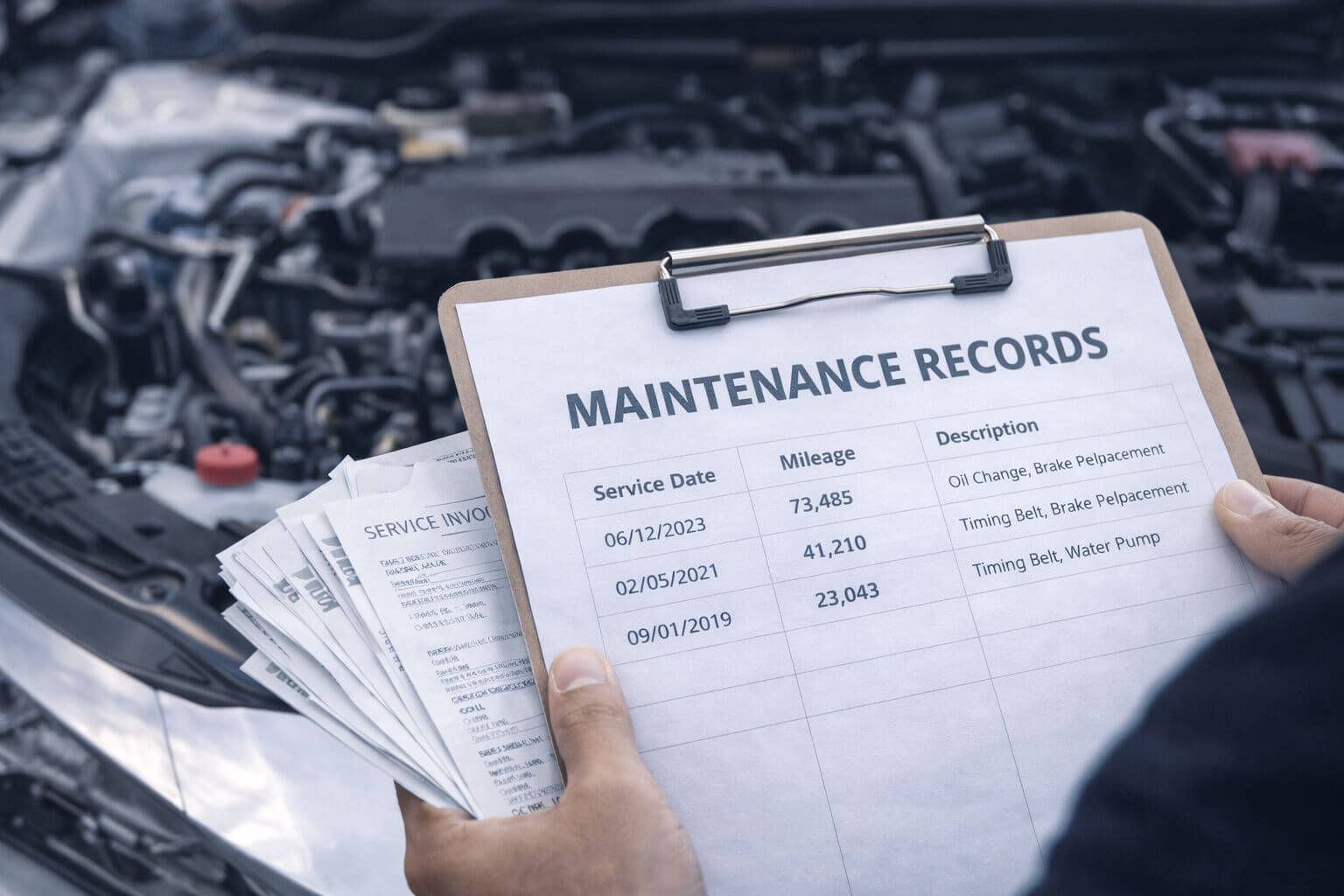
- Service records
- Warranty repair history
- Battery-related service documents
- Recall completion records
- Software update history
- Charging-system repairs
- Cooling-system repairs
- Brake service
- Tire replacement records
- Accident repair records
Software matters because some EV issues are corrected by updates. A vehicle that missed important updates or has unresolved service campaigns may need attention after purchase.
Inspect the high-voltage battery area
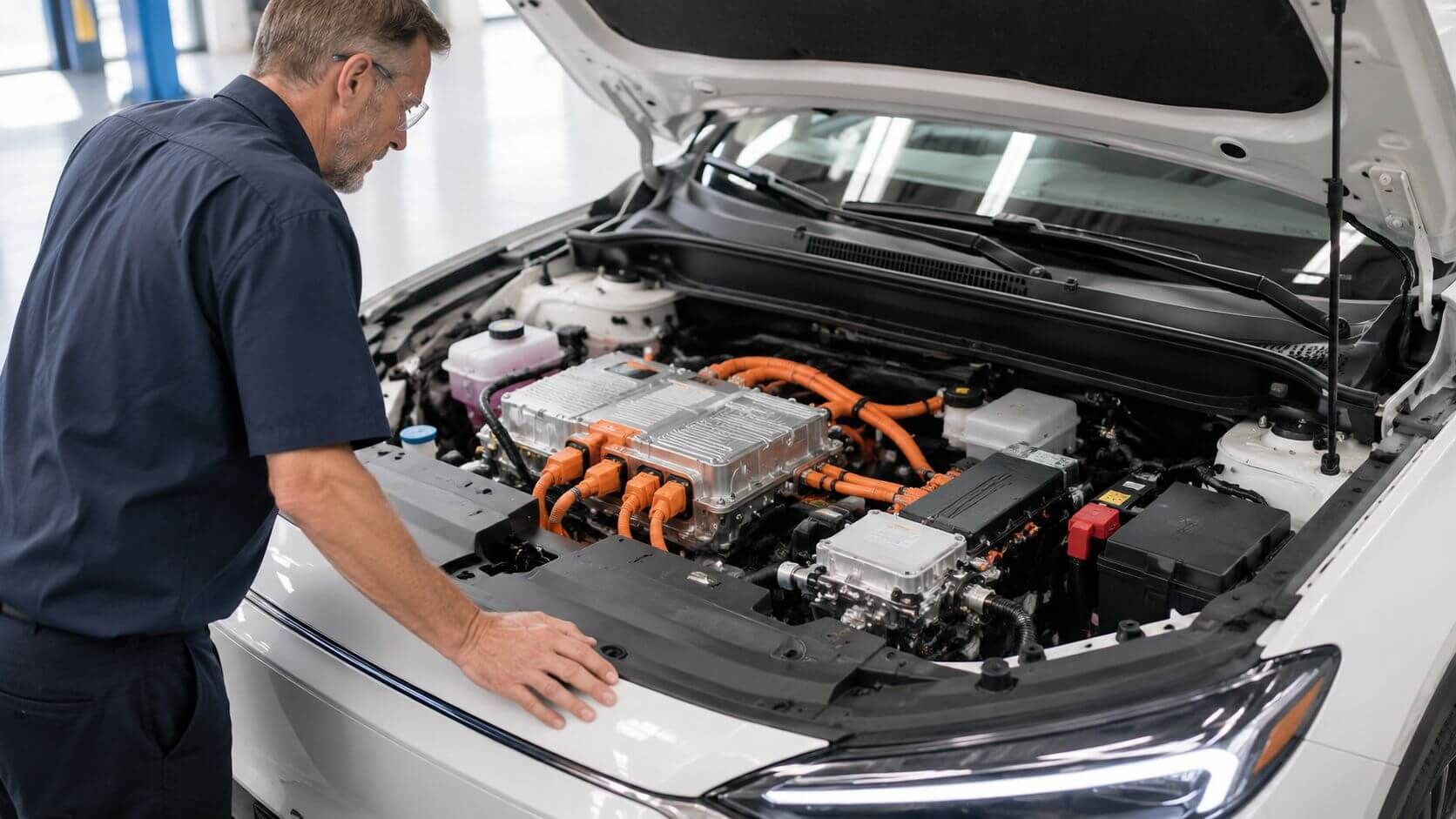
You do not need to open the battery pack. In fact, buyers should not attempt to inspect high-voltage components themselves. But a mechanic or EV-qualified technician can inspect the vehicle safely for signs of damage.
Ask the inspector to check:
- Undercarriage damage
- Battery enclosure damage
- Scrapes or dents near the battery pack
- Signs of coolant leaks
- Corrosion
- Previous collision damage
- Loose underbody panels
- Damaged charging port
- High-voltage warning codes
- Evidence of flood exposure
Battery pack damage, flood exposure, or poor collision repair can turn a used EV into a high-risk purchase.
Watch for flood and collision history
EV batteries are usually mounted low in the vehicle, often in the floor. That can be good for handling, but it also means underbody damage and water exposure deserve serious attention.
Be cautious if the vehicle has:
- Flood history
- Water intrusion
- Salvage or rebuilt branding
- Severe underbody damage
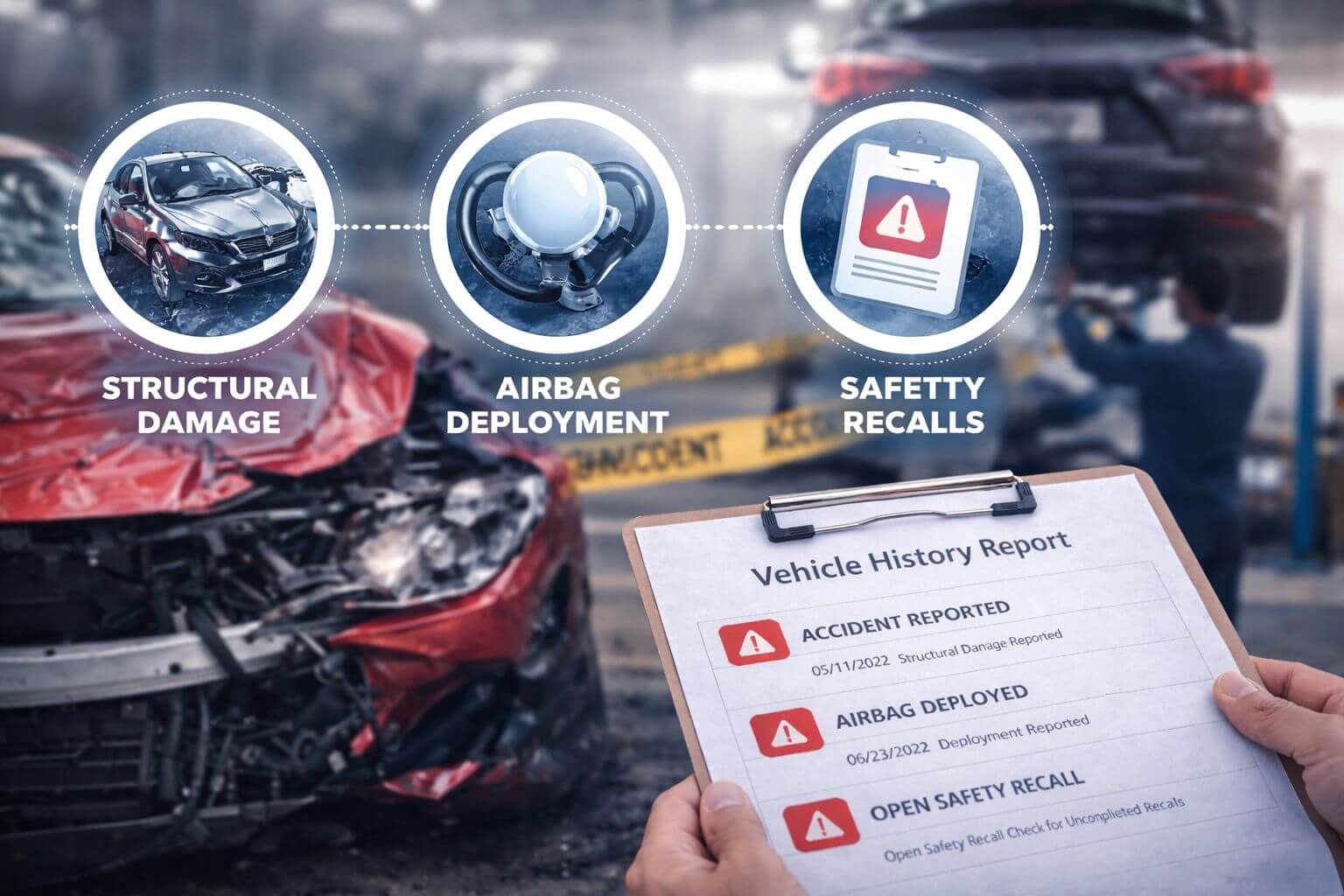
- Airbag deployment
- Structural repair
- Battery pack replacement
- Unknown collision repair
- Missing underbody shields
A repaired EV is not automatically a bad vehicle, but repairs involving the battery area, high-voltage wiring, or cooling system should be reviewed carefully by a qualified technician.
Compare the EV to your daily driving needs
A used EV does not need maximum range to be a good purchase. It needs enough usable range for your life.
Think through:
- Daily commute distance
- Winter driving distance
- Highway use
- Home charging access
- Condo or apartment charging access
- Workplace charging
- Public charging availability
- Weekend travel needs
- Family driving patterns
- Backup vehicle availability
- Charging time tolerance
A lower-range used EV can be excellent for commuting. It may be frustrating for long winter highway trips without reliable charging.
EV battery health checklist before buying
Use this checklist before paying for a used electric car:
- Confirm the VIN and vehicle history.
- Check the displayed range at a known battery percentage.
- Ask for a battery state-of-health report.
- Confirm remaining battery warranty.
- Verify whether warranty coverage transfers.
- Check for open recalls.
- Ask about charging habits.
- Inspect the charging port.
- Confirm included charging cables and adapters.
- Test charging if possible.
- Review service and software history.
- Check for battery-related warning messages.
- Inspect for underbody and battery-pack damage.
- Review accident, flood, and title history.
- Test drive long enough to observe range behaviour.
- Confirm winter range expectations.
- Have an EV-qualified technician inspect the vehicle.
- Make sure the price reflects battery condition and warranty status.
If the seller cannot answer basic battery questions, the vehicle may still be fine — but the uncertainty should affect your decision and negotiation.
Questions to ask the seller
Ask these before making an offer:
- What range do you normally get in summer?
- What range do you normally get in winter?
- Do you have a battery health report?
- Is the battery still under warranty?
- Has the battery ever been repaired or replaced?
- Has the vehicle had any battery or charging recalls?
- How often did you use DC fast charging?
- Did you usually charge at home?
- Was the car stored for long periods?
- Are all charging cables included?
- Has the vehicle ever had flood damage?
- Has the underside or battery area ever been damaged?
- Can I have the vehicle inspected by an EV-qualified technician?
A knowledgeable seller should be able to answer most of these clearly.
Red flags that should make you pause
Be careful if you see:
- No battery health information
- No remaining battery warranty on a high-risk vehicle
- Open battery or charging recalls
- Charging errors
- Sudden range drops
- Dashboard battery warnings
- Seller refuses a charging test
- Seller refuses an EV inspection
- Missing charging equipment
- Flood or severe collision history
- Battery-pack damage
- Vague answers about winter range
- Price far below market with no clear reason
One red flag may be explainable. Several together should make you walk away.
Final thoughts
A used EV can be a great purchase in Canada, but the battery must be checked carefully. The odometer alone does not tell the full story. Battery health, real-world range, winter performance, charging history, warranty coverage, recalls, and inspection results all matter.
Before buying, verify the battery’s state of health, confirm warranty coverage, check for recalls, inspect the charging system, and make sure the vehicle fits your daily driving needs. A clean body and low price are not enough if the battery condition is unclear.
The safest used EV purchase is one where the battery, warranty, service history, recalls, and real-world range all tell the same story.